
Dallas-Fort Worth Leak Detection Experts
Pool Leak Detection in Dallas-Fort Worth, TX
Your pool is losing more water than the Texas sun can explain. The pump is sucking air. The autofill runs constantly — or you are dragging the hose out every other day. A leaking pool in DFW is not just a water bill problem: it is thousands of gallons undermining your deck, washing out soil against your foundation, and running your equipment to death.
Pool leak ruled out but the water bill is still climbing? The problem may be in the house — see whole-home water leak detection, or emergency leak repair if water is surfacing now.
DFW Slab Leak Pros connects pool owners across Dallas-Fort Worth with licensed local pool leak detection specialists — the pros who pressure-test lines, dye-test fittings, and find the exact leak instead of guessing. Call (888) 555-0199 today. A pool leak found early is a repair; a pool leak found late is a renovation.
Request Your Free Leak Assessment
Licensed DFW leak-detection specialists. Same-day appointments across Dallas-Fort Worth. Detection fee credited in full toward your repair.
Prefer to talk right now? (888) 555-0199 — 24/7 emergency line
The Signs Your Pool Is Leaking — Not Just Evaporating
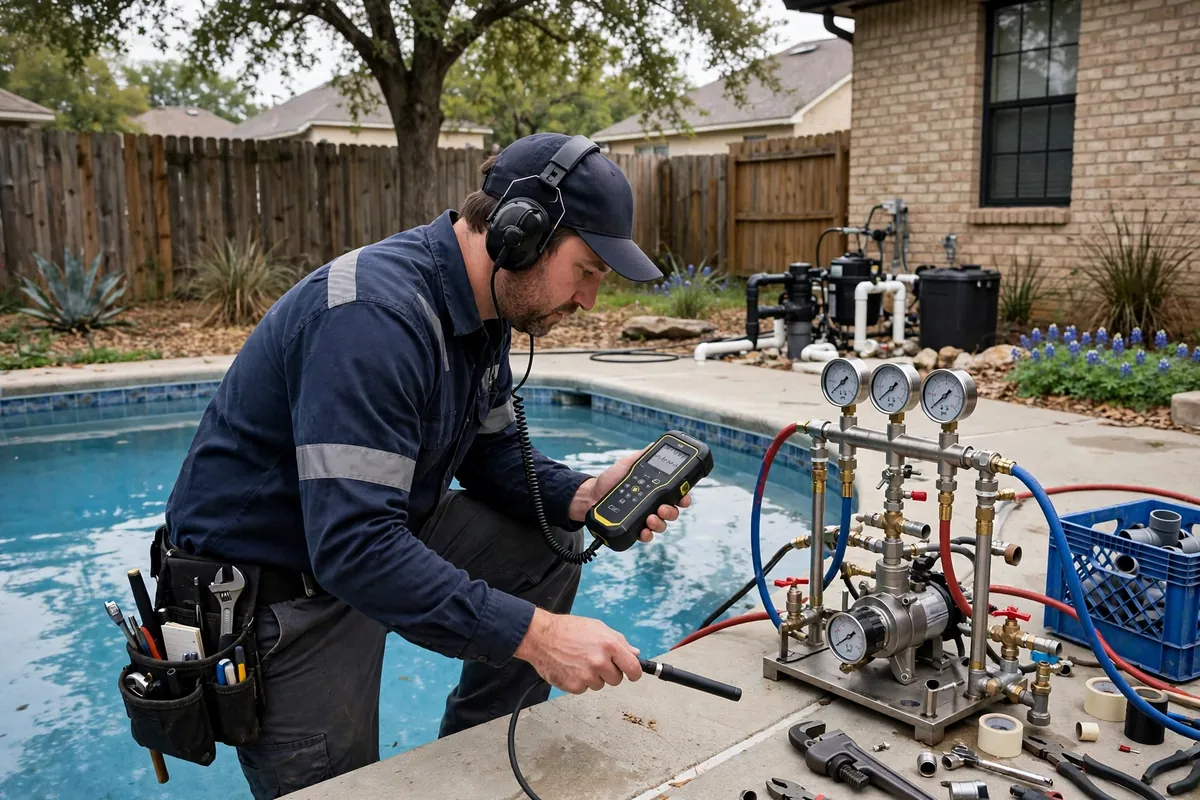
DFW summers evaporate serious water, so the first question is always evaporation versus leak. A professional settles it with a controlled comparison test — but these signs point to leak long before the test:
- Losing more than a quarter-inch per day. Normal DFW summer evaporation runs up to about a quarter-inch daily. Consistently losing more — especially in mild weather — means water is escaping somewhere it should not.
- Air in the pump basket or losing prime. The pump sucks air, the basket never stays full, or the system loses prime overnight. That is a suction-side leak pulling air into the plumbing.
- The autofill never stops — or the water level keeps dropping. If your autofill runs constantly or you are adding water every couple of days outside peak summer, the pool is losing water faster than evaporation accounts for.
- Cracks in the pool shell, deck, or tile line. DFW’s expansive clay — the same soil that swells up to 30% and cracks under-slab copper — moves under pools too. Shifting soil cracks shells, opens skimmer throats, and separates plumbing joints.
- Wet spots or soggy ground around the pool. Perpetually damp soil near the equipment pad or along the plumbing run means a pressure-side line is leaking underground.
- Chemicals that will not stabilize. Constant fresh water diluting the pool makes chlorine, pH, and alkalinity impossible to hold. If you are burning through chemicals, you are likely replacing leaked water.
- Equipment cycling or running hot. Pumps working against air leaks overheat and burn out early. A $1,500 pump killed by a $400 leak is the most expensive way to learn about pool plumbing.
Where Pool Leaks Actually Hide
Go through these one by one — a specialist checks them in this order because it is where DFW pools fail:
Skimmer throats and mouths. The number-one leak point on most pools. The skimmer is plastic set in concrete; DFW soil movement opens the joint between them, and water pours out behind the skimmer where you cannot see it.
Light niches. The conduit behind the pool light is a classic slow leaker. Water migrates up the conduit and out — often showing up as a wet spot far from the pool.
Return fittings and main drains. Hydrostatic pressure and soil movement crack fittings and loosen drain covers. A dye test — colored dye released at the fitting while the pump is off — shows instantly whether water is being pulled in.
Underground plumbing lines. Suction and return lines run buried from the pool to the equipment pad. In expansive clay, joints separate and pipes crack. These are found with isolated pressure testing, line by line.
Shell cracks. Structural cracks from soil movement leak continuously. Surface cracks in plaster are often cosmetic; cracks that go through the shell are not — a specialist distinguishes them instead of guessing.
How Professional Pool Leak Detection Works
- Pressure testing each line — every suction and return line is isolated and pressurized. A line that will not hold pressure has a break; a line that holds is eliminated. This narrows the search before anyone gets wet.
- Dye testing — with the pump off, dye is released at suspect fittings, cracks, and light niches. If the dye is drawn in, that is the leak — visible, verifiable, exact.
- Acoustic listening — for underground plumbing, sensitive listening equipment picks up the sound of pressurized water escaping buried lines, pinpointing the break without trenching the yard.
- Structural inspection — the shell, tile line, skimmers, and deck joints are inspected for the movement cracks DFW’s clay soil causes.
The result is a located leak (or leaks — pools often have more than one) with a repair plan and honest pricing, usually in a single visit.
What Pool Leak Detection and Repair Costs in DFW
- Detection visit: typically $350–$450 for a full pool leak detection — pressure testing, dye testing, and structural inspection.
- Skimmer or fitting repair: a few hundred dollars when the leak is at an accessible fitting or skimmer throat.
- Underground line repair: $1,000–$3,000+ depending on location and access — precise locating keeps this to a targeted dig, not a yard excavation.
- Structural crack repair: varies widely with the crack; staples, epoxy injection, or replastering depending on severity.
Compare that to what the leak costs while it runs: thousands of gallons on the water bill every month, chemical costs doubling, a burned-out pump, deck settlement from washed-out soil — and in the worst case, water migrating toward your home’s foundation. Detection is the cheapest line item in every scenario.
A Note for Pool Owners: Who Handles These Jobs
Pool leaks are a specialty within a specialty. The companies that buy and service pool-leak work are pool service and pool repair companies — not general plumbers. They carry the pressure-testing rigs, dye, and acoustic gear specific to pools, and they do this work daily across DFW’s enormous pool stock. When you call (888) 555-0199, DFW Slab Leak Pros connects you with licensed local specialists experienced specifically in pool leak detection — not a generalist figuring it out on your dime. If your problem is inside the house rather than the pool, see water leak detection or, for active flooding, emergency leak repair.
Why a Pool Leak Cannot Wait Out the Season
“I will deal with it when swim season ends” is the most expensive sentence in pool ownership. A leaking pool keeps leaking through fall and winter — and DFW’s wet winters saturate the same expansive clay that is already moving under your deck. Every month of delay washes more soil from under the deck and equipment pad, opening settlement cracks that turn a plumbing repair into concrete work. Meanwhile the EPA’s WaterSense program estimates household leaks waste enormous volumes nationally — your pool’s share is on your water bill every month.
Our guarantee: the detection fee is credited in full toward your repair. You get a written quote before any work starts — method, materials, warranty, license number. No exploratory digging, no surprise add-ons.
Call (888) 555-0199 now. One detection visit, the leak located exactly, and a repair plan with honest pricing — before the next water bill, before the next cracked deck section, before the pump gives out.
Pool Leak Detection
Your Water Bill Knows Before You Do
A pool leak rarely announces itself with a puddle — it shows up on the water bill first. If your bill jumped $50, $100, or more with no change in household usage, and the pool is losing more than a quarter-inch a day to evaporation, you likely have a structural or plumbing leak. Do the bucket test: place a bucket of pool water on a step, mark both levels, wait 24 hours. If the pool dropped more than the bucket, water is leaving through a leak, not the air. Then call (888) 555-0199 — pressure testing and acoustic equipment will find whether it is the shell, the skimmer, or the underground lines.
FAQs — Dallas-Fort Worth
How can I tell if my pool is leaking or just evaporating?
DFW summer evaporation runs up to about a quarter-inch per day. Losing consistently more — especially in mild weather — points to a leak. A professional settles it definitively with a controlled comparison test plus pressure testing of the plumbing lines.
How much does pool leak detection cost in DFW?
Typically $350–$450 for a full detection visit: pressure testing every line, dye testing fittings and cracks, and structural inspection. Most pools are fully diagnosed in a single visit.
Where do pool leaks most commonly occur?
Skimmer throats are the number-one spot, followed by light niches, return fittings, underground plumbing joints, and structural shell cracks. DFW’s expansive clay soil movement is behind most of them.
Can you find a leak in underground pool plumbing without digging up my yard?
Yes. Lines are pressure-tested individually to identify the broken one, then acoustic listening equipment pinpoints the break’s location underground. Any digging is a single targeted repair excavation.
My pool equipment is making noise and losing prime. Is that a leak?
Almost certainly a suction-side leak — air is being pulled into the plumbing through a break. It starves the pump, overheats equipment, and gets worse. Shut the system down if it is struggling and call for detection before the pump burns out.
Do you repair the leak or just find it?
The detection visit locates every leak and comes with a repair plan and honest pricing. Most pool leak specialists also perform the repairs — skimmer rebuilds, fitting replacement, line repairs — so one call typically handles the whole job.
Losing water every day? Stop feeding the leak. Call (888) 555-0199 — DFW Slab Leak Pros connects you with licensed local pool leak specialists across Dallas, Plano, Frisco, and the full DFW metro.
Water Where It Shouldn’t Be? Don’t Wait.
Every hour a leak runs, the damage — and the repair bill — keeps growing.