
Serving Fort Worth, Texas
Leak Detection in Fort Worth, TX
Fort Worth sits on some of the most aggressive expansive clay in the metro — Blackland Prairie soil that can swell up to 30% when wet and shrink back in drought, moving slabs inches with the seasons. Add the aging copper and galvanized supply lines under Fort Worth’s older districts, and hidden leaks here are a matter of when, not if. If you need 24/7 leak detection in Fort Worth, get a licensed local specialist on it before a small leak becomes a foundation problem.
Fort Worth homeowners get our full slab leak detection service — and if you are south of the metro, see our Arlington leak detection page.
Fort Worth · aging copper & galvanized on expansive clay · high slab-leak risk
DFW Slab Leak Pros connects Fort Worth homeowners and property managers with licensed local leak detection specialists who locate hidden leaks fast — acoustic listening, thermal imaging, pressure testing — and lay out honest repair options.
Request Your Free Leak Assessment
Licensed DFW leak-detection specialists. Same-day appointments across Dallas-Fort Worth. Detection fee credited in full toward your repair.
Prefer to talk right now? (888) 555-0199 — 24/7 emergency line
Fort Worth’s Expansive Clay Is the Main Enemy
Plenty of Texas cities have old pipes. What makes Fort Worth different is how hard the ground itself fights your plumbing. The expansive clay verified locally under Fort Worth neighborhoods is among the most volatile in DFW:
- Inches of seasonal movement. Summer drought shrinks the clay away from the slab; spring rains swell it back with enormous force — and every cycle bends the pipes trapped inside.
- Foundation heave and settlement. When soil under one side of the slab swells and the other shrinks, the slab tilts — snapping rigid copper joints and cracking drain lines.
- Water intrusion from failed lines feeds the cycle. A leaking under-slab pipe saturates the clay, which swells and heaves the foundation further — the leak literally makes the soil problem worse, which makes the leak worse.
The pipes under Fort Worth homes
Fort Worth’s older districts still carry original copper and galvanized supply lines — galvanized corrodes from the inside out; copper survives longer but eventually succumbs. The 1960s–80s under-slab copper across the city is the danger era: thermal expansion abrades copper against concrete every hot-water cycle, while the clay flexes every joint. 1990s builds generally got better pipe bedding and hold up longer; post-2000 construction shifted to PEX, which rarely leaks — but most of Fort Worth’s housing predates that shift.
On expansive clay, every week a leak runs is a week of accelerating soil movement under your foundation — which is why fast 24/7 leak detection in Fort Worth matters.
Warning Signs Fort Worth Homeowners Shouldn’t Ignore
- Water bills climbing with no change in usage.
- Warm spots on floors — a leaking hot-water line heats the slab.
- Running-water sounds when fixtures are off.
- Mildew odors from trapped water intrusion.
- Cracks in walls or tile as soil shifts.
- Water coming up through the floor — the worst sign; a failure in progress.
In Fort Worth, a slab leak left running doesn’t just waste water — it destabilizes the ground your house sits on. Spotted any of these? Call (888) 555-0199 for a licensed Fort Worth leak detection specialist — same-day appointments available.
How Licensed Specialists Pinpoint Fort Worth Leaks
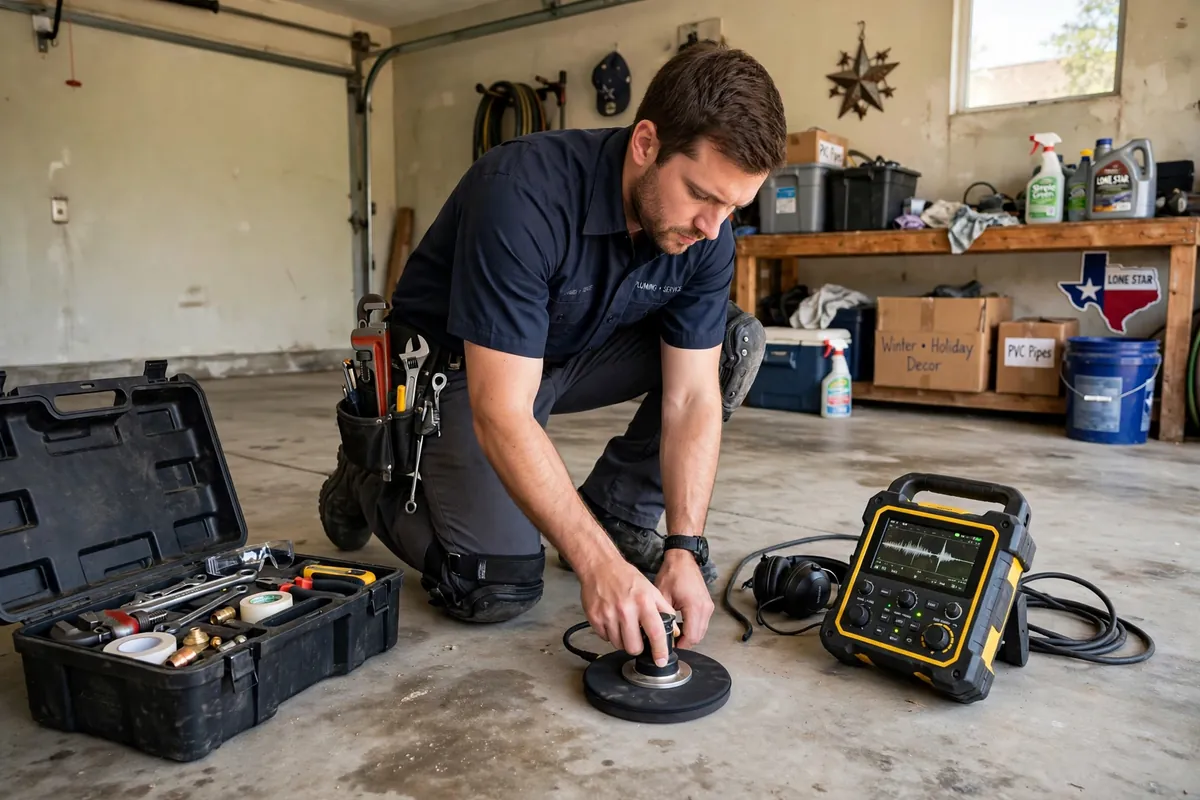
On Fort Worth’s shifting soil, precise location matters — no exploratory demolition on an already stressed slab. Specialists work non-destructively: acoustic listening detects the hiss of escaping water through concrete, thermal imaging maps warm and cool anomalies through the slab, pressure testing proves which line is failing, and hydrostatic testing covers drain-side leaks.
Detection typically costs $300–$600 in Fort Worth and is usually credited toward the repair — certainty instead of guesswork, and on expansive clay, certainty is what keeps a small repair from becoming a foundation project.
Repair Options: Reroute vs. Repipe in Fort Worth
The industry standard for a failed under-slab line is abandon-and-reroute — not jackhammering through the slab to patch it. A reroute runs a new line through walls or the attic: $3,000–$6,000 per line. Where original copper is broadly at failure age, a full repipe ($12,000–$25,000) is often the better long-term call — fixing one pinhole while the rest of the 1970s copper sits in shifting clay just schedules your next emergency.
Emergency? Water coming up through the floor, a spinning meter, or sudden pressure loss — shut the main valve and call (888) 555-0199 now. We’ll connect you with a licensed local specialist who can respond fast.
Also serving nearby: Leak Detection in Arlington, TX, Leak Detection in Irving, TX, Leak Detection in Dallas, TX, and Leak Detection in McKinney, TX. Related services: Slab Leak Detection, Water Leak Detection.
Frequently Asked Questions
Are slab leaks common in Fort Worth?
Yes — Fort Worth sits on some of the most aggressive expansive clay in the metro, and its older districts run original copper and galvanized lines now at failure age. The 1960s–80s under-slab copper across the city is the danger era for thermal expansion and abrasion. That combination gives Fort Worth one of the highest slab leak rates in DFW.
My water bill spiked but nothing is visibly leaking — slab leak or irrigation?
Shut the irrigation controller completely off and watch the meter. If it still runs, the leak is in the house system or service line — not the sprinklers. Warm floor spots, water sounds with everything off, or water coming up through the floor point to a slab leak. A specialist confirms it with acoustic listening and pressure testing.
How much does leak detection cost in Fort Worth?
Typically $300–$600 for a full diagnostic visit — acoustic listening, thermal imaging, and pressure testing — with most straightforward homes landing near the lower end. Most reputable companies credit the detection fee toward your repair.
Why does Fort Worth have so many slab leaks?
Fort Worth sits on highly expansive Blackland Prairie clay that swells up to 30% and moves slabs inches per season, flexing and fatiguing the pipes inside. Combined with 1960s–1980s copper and galvanized lines now at failure age, the metro has one of the highest slab leak rates in the US.
Do you offer 24/7 leak detection in Fort Worth?
Yes. DFW Slab Leak Pros connects you with licensed specialists offering 24/7 leak detection in Fort Worth for emergencies like water coming up through the floor. Call (888) 555-0199 any time.
Is it better to repair a slab leak or reroute the line?
Reroute. The industry standard is to abandon the failed under-slab line and run a new one through walls or the attic ($3k–$6k per line). Breaking through the slab to patch old pipe is rarely recommended — the surrounding pipe is the same age and will fail next, and you risk further disturbing an already stressed slab.
Can a slab leak damage my foundation in Fort Worth?
Absolutely — and faster here than in most cities. Leaking water saturates the expansive clay, which swells and heaves the foundation. What starts as a plumbing leak becomes a foundation problem if it runs long enough.
What does mold risk have to do with slab leaks?
Water trapped under and around a slab creates persistent dampness — ideal conditions for mold growth inside wall cavities and flooring, even before you see water. Source: epa.gov
Water Where It Shouldn’t Be? Don’t Wait.
Every hour a leak runs, the damage — and the repair bill — keeps growing.
When the Water Company Tips You Off in Fort Worth
Here is how most Fort Worth leak calls actually start: the Fort Worth Water Department notices abnormal usage on your meter and sends a high-bill notice or leak alert — sometimes weeks before you see a damp spot or hear running water. Do not ignore it. A slab or supply-line leak can waste thousands of gallons a month, and in Fort Worth’s expansive clay soil, that water does foundation damage while it runs. Shut everything off and check your meter: if the dial moves with zero water use, call (888) 555-0199 for same-day leak detection in Fort Worth.