
Dallas-Fort Worth Leak Detection Experts
Sewer Line Leak Detection in Dallas-Fort Worth, TX
There is a sewage smell in your yard that was not there last month. Two drains back up at the same time. One patch of grass is suspiciously greener than the rest of the lawn. In DFW, these are not plumbing annoyances — they are the early warnings of a sewer line break, and a broken sewer line under your yard or slab is a health hazard, a foundation threat, and a repair that gets dramatically more expensive the longer it runs.
Sewer leaks are a different beast from supply-line leaks — if you are not sure which you have, our water leak detection page covers the distinction, and slab leak detection handles pressurized lines under the foundation.
DFW Slab Leak Pros connects homeowners across Dallas-Fort Worth with licensed local specialists who locate sewer line breaks with camera inspection, hydrostatic pressure testing, and smoke testing — no exploratory digging. Call (888) 555-0199 today. Finding the break precisely is what keeps a sewer repair from becoming a landscaping demolition.
Request Your Free Leak Assessment
Licensed DFW leak-detection specialists. Same-day appointments across Dallas-Fort Worth. Detection fee credited in full toward your repair.
Prefer to talk right now? (888) 555-0199 — 24/7 emergency line
The Warning Signs of a Sewer Line Break
Sewer failures announce themselves in patterns. Go through these one by one:
Sewage odor in the yard or house. A persistent rotten-egg or sewage smell near drains, in the yard, or — worst case — inside the home means wastewater is escaping the line. This is not a venting quirk. It is a breach, and it is a health issue from day one.
Multiple drains backing up at once. One slow drain is a clog. The tub, the toilet, and the shower all backing up together means the problem is in the main line, downstream of everything. If flushing the toilet makes the shower gurgle, the main sewer line is compromised.
A suspiciously lush patch of lawn. Wastewater is fertilizer. A strip of grass that is greener, taller, and faster-growing than the rest of the yard — especially in a line running from the house toward the street — is growing over a leaking sewer line.
Soggy ground that never dries. A perpetually wet or sunken area in the yard, even in dry DFW summers, means liquid is surfacing from below. Combined with odor, this is a near-certain sewer break.
Gurgling sounds from drains and toilets. Air trapped by a partial collapse or blockage bubbles back through fixtures. Gurgling across multiple fixtures points to the main line, not a single drain.
Foundation cracks appearing near the line path. A long-running sewer leak washes soil out from under the slab, leaving voids. The slab settles into the void and cracks. In DFW’s expansive clay, this compounds fast — the soil that swells up to 30% when wet is being saturated continuously from below.
The working solution for every one of these: a professional sewer line inspection that locates the break exactly — before anyone brings a shovel.
Why DFW Sewer Lines Fail
- Expansive clay soil movement. Blackland Prairie clay swells up to 30% and shifts inches seasonally. Rigid sewer pipe — especially older cast iron and clay tile — cannot flex with it. Joints separate, pipes belly (sag), and cracks open.
- Cast iron at end of life. DFW homes from the 1960s–1970s often have original cast iron sewer lines. After 50+ years underground in corrosive soil, cast iron scales, rusts through, and collapses. If your home is in this age range and you have never had the sewer line inspected, you are overdue.
- Tree root intrusion. DFW’s mature oaks and pecans send roots hunting for moisture. A tiny joint separation becomes a root highway; roots widen the gap until the line is choked or broken.
- Bellies from soil settlement. Where the clay has settled unevenly, sewer lines develop low spots — bellies — where waste and paper collect instead of flowing. Bellies become chronic backup points and eventually fail.
How Professionals Find a Sewer Line Break
Modern sewer detection is surgical. A licensed DFW specialist will:
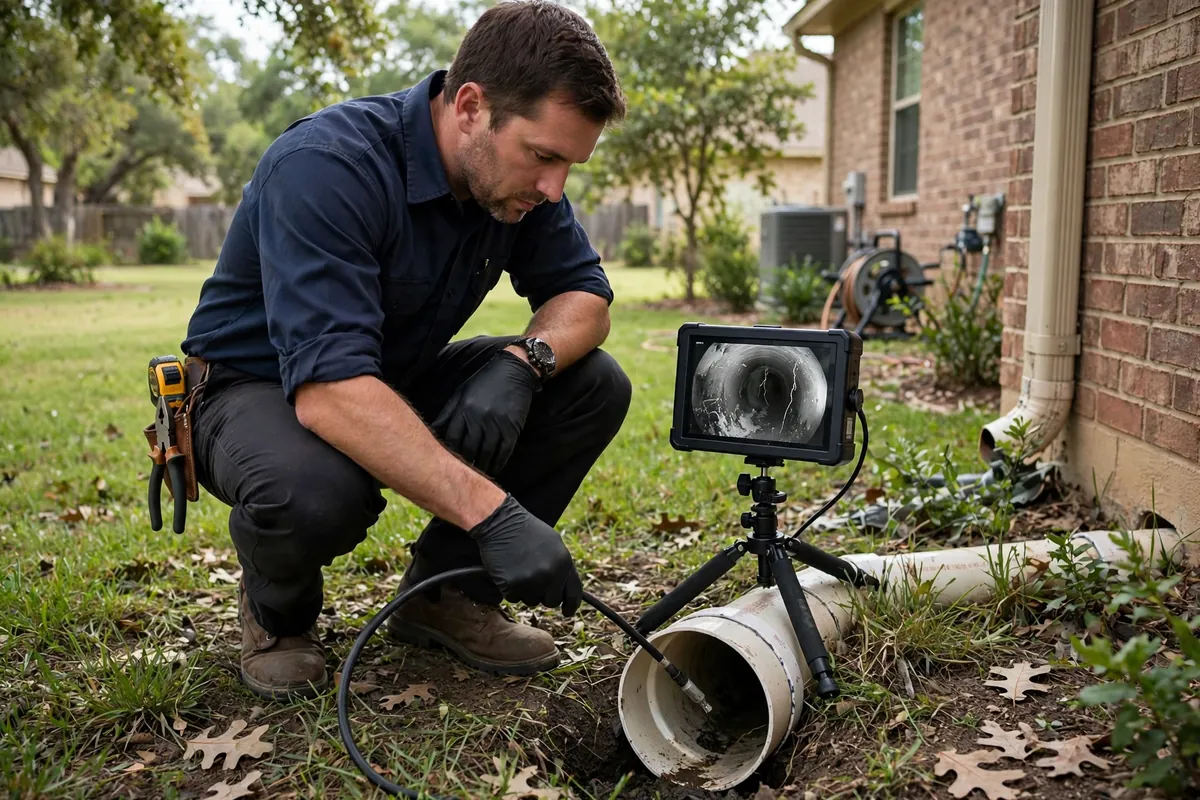
- Run a camera inspection — a high-resolution camera on a flexible rod travels the full line from a cleanout, showing cracks, breaks, root intrusion, bellies, and collapses in real time, with the exact footage marked.
- Hydrostatic pressure testing — the line is isolated and filled to test whether it holds. Pressure loss confirms a breach and narrows its location when combined with camera footage.
- Smoke testing — non-toxic smoke is forced through the system; where it surfaces pinpoints breaks and open joints, including ones the camera cannot easily characterize.
- Line locating and depth marking — the break’s position is traced from above ground and marked, so any excavation is a single targeted dig, not a trench across the yard.
You get video evidence of the break, its exact location and depth, and a repair plan — usually in one visit.
What Sewer Line Detection and Repair Costs in DFW
- Camera inspection / detection visit: typically $300–$600, credited in full toward the repair when you hire the same company for the fix.
- Spot repair (targeted dig): $1,500–$6,000+ depending on depth, location (under slab vs. yard), and access. Precise locating is what makes a spot repair possible.
- Trenchless repair / pipe lining: priced per foot; viable when the old line is mostly intact but cracked. Not every line qualifies — collapsed sections cannot be lined.
- Full line replacement: $8,000–$20,000+ depending on length, depth, and whether it runs under the slab, driveway, or landscaping. Tunneling under the foundation from outside is the DFW alternative to breaking through interior floors.
On insurance: as with water lines, the pipe repair itself is usually NOT covered (wear and tear), while sudden resulting damage sometimes is. Sewer backup riders are a separate, inexpensive endorsement many DFW homeowners do not know they lack — ask your agent. If sewage is actively backing into the home, treat it as an emergency: stop using water and see our emergency leak repair page.
Why a Sewer Leak Cannot Wait
A sewer break is the one leak category where waiting creates dangers beyond money. Wastewater under your slab or in your yard is a health hazard — category 3 black water carrying bacteria and pathogens. The EPA’s guidance on moisture and mold applies here with extra force: constant sewage moisture breeds mold and contamination where your family lives and plays.
Structurally, a running sewer leak washes supporting soil from under the slab, creating voids. The slab settles, cracks widen, and what started as a $4,000 spot repair becomes a foundation repair plus a sewer replacement. Every flush through a broken line makes the void bigger.
Our guarantee: the detection fee is credited in full toward your repair. You get a written quote before any work starts — method, materials, warranty, license number. And no-dig options are quoted on every job, including trenchless lining where your line qualifies.
Call (888) 555-0199 now. DFW Slab Leak Pros connects you with licensed local sewer specialists — camera in the line, break located, honest repair options, no exploratory digging. Property managers and businesses: see commercial leak detection for multi-unit and building sewer issues.
Sewer Line Leak Detection
Do You Have the Equipment to Actually Find It?
Fair question — and the one you should ask any company before booking. For sewer lines, the answer is a waterproof camera on a push-rod, fed through a cleanout, showing the inside of your pipe in real time: cracks, bellies, root intrusions, offsets, and collapses, measured to the foot so we know exactly where to dig — or whether trenchless repair is an option. No camera, no diagnosis. Ask for the video file after the inspection; a reputable company hands it over without hesitation.
FAQs — Dallas-Fort Worth
How do I know if my sewer line is broken or just clogged?
One slow drain is usually a clog. Multiple fixtures backing up at once, sewage odors, gurgling across drains, or a suspiciously green strip of lawn point to a broken main line. A camera inspection settles it definitively in one visit.
How much does sewer line leak detection cost in DFW?
A camera inspection and detection visit typically runs $300–$600 — credited in full toward the repair with the same company. Compared to digging up a yard on a guess, it pays for itself immediately.
Will you have to dig up my whole yard?
No. Camera inspection plus line locating marks the break’s exact position and depth from above ground. Excavation — when needed — is a single targeted dig at the marked spot, not a trench across the property.
What is the difference between a belly and a break?
A belly is a sagging low spot where waste collects; a break is a cracked or separated pipe leaking wastewater into the soil. Both show on camera. Bellies cause chronic backups; breaks cause soil washout and contamination. The repair approach differs, which is why the camera inspection comes first.
Can a sewer line be repaired without digging?
Sometimes. Trenchless pipe lining works when the old line is cracked but structurally intact — a new liner is cured inside the old pipe. Collapsed or severely bellied sections cannot be lined and need excavation or tunneling. The camera inspection determines which you qualify for.
Is a sewer backup an emergency?
Yes, if wastewater is entering the home — stop using water immediately and call for emergency response. Sewage is a health hazard, not just a plumbing problem. If the signs are odors or a green lawn strip with no interior backup, schedule detection within days.
Smell sewage? Do not wait for the backup. Call (888) 555-0199 — DFW Slab Leak Pros connects you with licensed local sewer line specialists across Dallas, Fort Worth, Arlington, and the full DFW metro. Also see water leak detection for supply-side leaks.
Water Where It Shouldn’t Be? Don’t Wait.
Every hour a leak runs, the damage — and the repair bill — keeps growing.